
Heat Treatment in Forging - Strength, Durability & Performance
Heat treatment is a behind-the-scenes engineering hero. You don't see it once the part is assembled, but you feel its impact every time a vehicle turns, lifts, brakes or pulls a load. For safety-critical forged components, heat treatment is not an optional step - it is what transforms shaped steel into a reliable, long-lasting performer.
Think of forging as shaping the dough. Dough in this context is the hot, malleable steel. Heat treatment is the careful conditioning that gives it the right texture, strength and resilience.
Why Heat Treatment Matters in Engineering
Forged parts are designed to work under stress - constant loads, repeated cycles, sudden shocks. Without proper heat treatment, even the best forging can fail prematurely. Heat treatment gives forged components the ability to resist fatigue, absorb impact, and maintain dimensional stability, making it essential for automotive, agriculture, hydraulics, and heavy equipment applications.
Also read: Types of Hydraulic Parts Used in the Automotive Industry
This is why global OEMs and every serious automotive parts exporter treat heat treatment as a core quality driver, not a secondary process.
What Heat Treatment Actually Does to Steel
At a metallurgical level, steel is not static. Its internal structure changes with temperature.
Heat treatment works by:
- Refining grain structure, making steel stronger and more uniform
- Relieving internal stresses created during forging
- Improving hardness and wear resistance
- Transforming microstructure to suit the application
A simple analogy: heat treatment is like tuning the engine of the metal. The forging gives the shape, but heat treatment determines how well it performs.
Normalizing - Setting the Steel's Internal Structure Right
Normalizing is the foundation stage.
The forged component is heated to a specific temperature and cooled in air. This process:
- Refines grain size
- Removes residual stresses
- Creates a uniform internal structure
Normalizing prepares steel for further heat treatment and ensures consistency before moving to harder, more demanding stages.
Quenching - Creating High Strength for Demanding Loads
Quenching is where strength is built.
After heating, components are cooled rapidly using controlled media. This locks in hardness and improves load-bearing capability. Quenching is commonly applied to parts such as:
- Pinions and flanges
- Steering knuckles and stub axles
- Steering arms and hydraulic rod ends
- Lock jaws, kingpins, pivot pins
These are components that exporters supply to demanding global markets, where performance under load is non-negotiable.
20th Century Innovations - Drop Hammers, Hydraulic Presses & Standardization
Tempering - Balancing Toughness and Ductility
Hardness alone is not enough.
Tempering gently reheats quenched steel to restore toughness and ductility. It prevents brittleness and improves fatigue life. Without tempering, hardened parts may crack under real-world conditions.
In simple terms, tempering teaches steel how to bend without breaking.
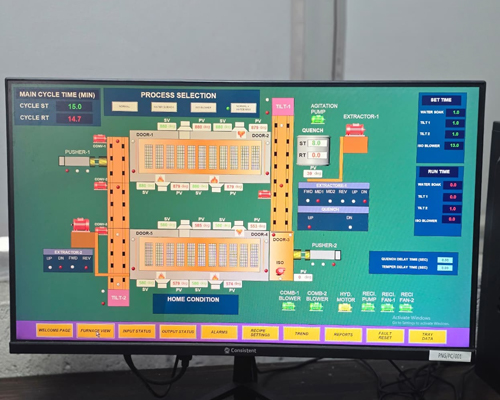
SCADA & CQI-9 - Heat Treatment with Total Digital Control
Modern heat treatment is no longer manual or approximate.
SCADA-enabled systems monitor temperature, soak time, and cooling rates in real time. When aligned with CQI-9 standards, this digital control delivers:
- Predictable mechanical properties
- Batch-to-batch consistency
- Full process traceability
This level of control is essential for components supplied to global automotive and heavy-equipment OEMs.
Testing Methods - Hardness, Microstructure & Ultrasonic Checks
Before dispatch, every heat-treated batch is validated through:
- Hardness testing to confirm strength levels
- Microstructure analysis to verify grain formation
- Ultrasonic testing to detect internal flaws
These checks close the loop between theory and performance.
How Heat Treatment Strengthens Automotive & Heavy Equipment Parts
From crankshafts and yokes to brake components and steering assemblies, heat treatment means forged parts can survive millions of operating cycles. It is the reason these components continue performing long after others fail.
Conclusion - Heat Treatment as the Secret Behind Long-Life Forgings
Heat treatment is not just a process step - it is the difference between average and exceptional performance.
At Forge Auto, heat treatment is fully integrated with forging, machining, testing and digital monitoring. This end-to-end control allows us to deliver forged components trusted across automotive, agriculture, hydraulics and global export markets.
If you are looking for forged components engineered for long life and consistent performance, Forge Auto is ready to be your manufacturing partner.
About us
Founded in 2001, Forge Auto International Ltd. (FAI) started as a small manufacturing unit. Over the years, we have grown into a modern, professionally managed company known for delivering quality and reliability.

